
Teaching Physics Tips - Work, Energy, and Power
General theory - some stories and a few little practicals.

General theory for this section:
Work (W)
Work is done when a force causes displacement:
\(W = F d \cos \theta\)Where:
F = applied force (N)
d = displacement (m)
theta = angle between force and displacement
Units: joules (J)
No work is done if there is:
No displacement
Force perpendicular to displacement (e.g. circular motion)
Energy
Energy is the capacity to do work.
Kinetic Energy:
Energy of a moving object:
\(\begin {align}E_k &= \frac{1}{2} m v^2 \\ \text{Where: }\\ m &\text{ is mass (kg) and}\\ v &\text{ is speed (m/s)}\\ \end{align}\)
Gravitational Potential Energy ($E_p$)
Energy due to position in a gravitational field:
\(\begin{align} E_p &= m g h \\ \text{Where:}\\ g &= 9.81 \text{m/s}^2 \text{ (on Earth),} \\ h &\text{ is height (m)} \end{align}\)
Elastic Potential Energy
Stored in stretched/compressed springs:
\(\begin{align} E &= \frac{1}{2} k x^2\\ \text{Where:}\\ k &\text{ is spring constant (N/m),}\\ x &\text{ is extension/compression (m)} \end{align}\)
Conservation of Energy
Total energy is conserved in a closed system:
\(\text{Total energy in} = \text{Total energy out}\)Energy can be transformed (e.g. potential ↔ kinetic) but not created or destroyed.
Power (P)
Power is the rate of doing work or transferring energy:
\(P = \frac{W}{t} = \frac{E}{t}\)Where:
W = work done (J)
t = time (s)
Units: watts (W),
Efficiency
A measure of how much input energy is usefully transferred:
\(\text{Efficiency} = \frac{\text{useful output energy}}{\text{input energy}} \times 100\%\)
Stories to enrich
Hero’s Steam Engine: The First Work Done by Steam
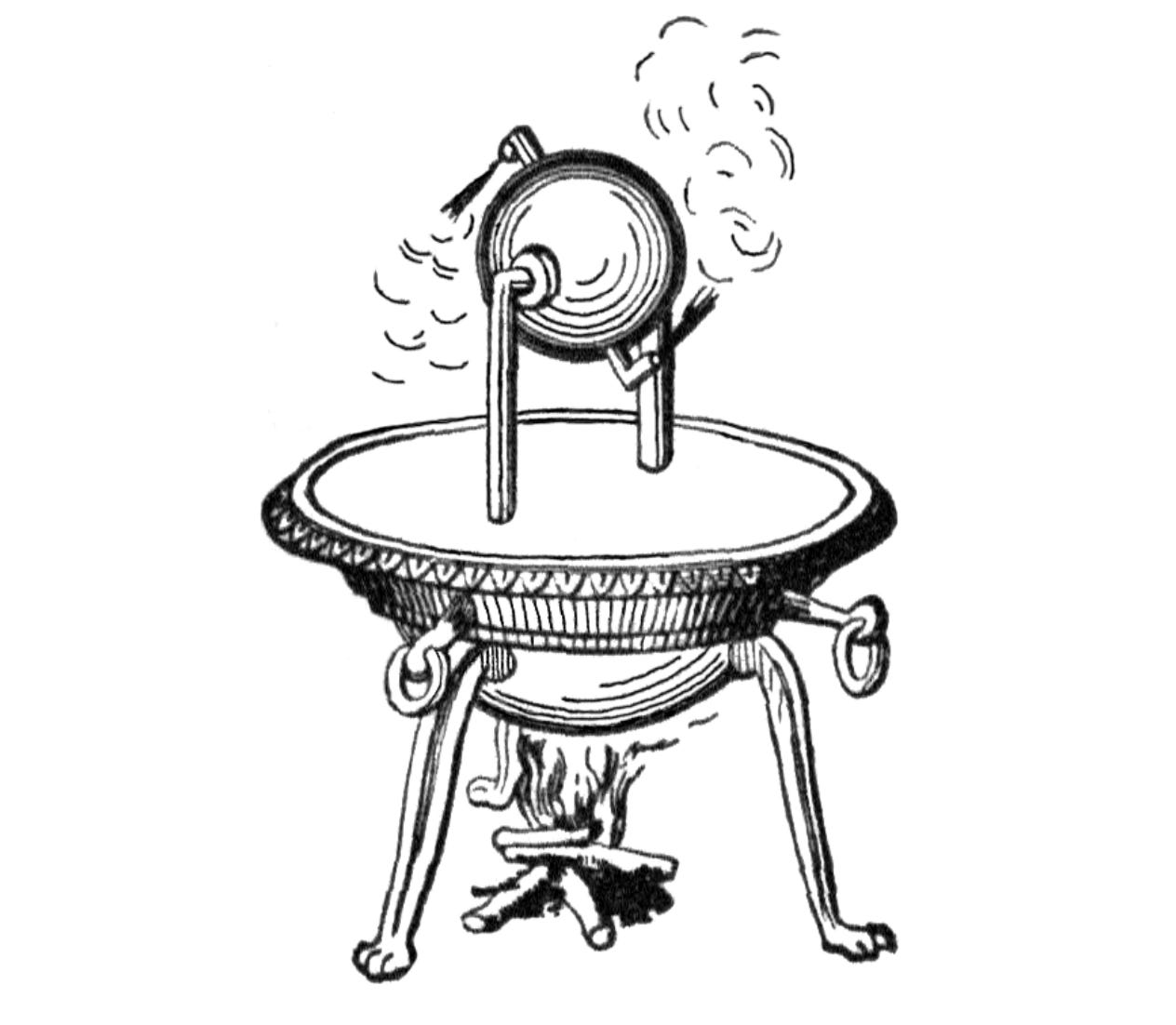
Though called Hero’s engine, Vitruvius’s (c. 80 BC – c. 15 BC) was the first to mention aeolipiles by name:
Aeolipilae are hollow brazen vessels, which have an opening or mouth of small size, by means of which they can be filled with water. Prior to the water being heated over the fire, but little wind is emitted. As soon, however, as the water begins to boil, a violent wind issues forth.[6]
Hero (c. 10–70 AD) takes a more practical approach, in that he gives instructions how to make one:
PLACE a cauldron over a fire: a ball shall revolve on a pivot. A fire is ignited under a cauldron, A B, (fig. 50), containing water, and covered at the mouth by the lid C D; with this the bent tube E F G communicates, the extremity of the tube being fitted into a hollow ball, H K. Opposite to the extremity G place a pivot, L M, resting on the lid C D; and let the ball contain two bent pipes, communicating with it at the opposite extremities of a diameter, and bent in opposite directions, the bends being at right angles and across the lines F G, L M. As the cauldron gets hot it will be found that the steam, entering the ball through E F G, passes out through the bent tubes towards the lid, and causes the ball to revolve, as in the case of the dancing figures.
Rather oddly it appears that nobody thought to do anything with these machines for centuries after this. Their main use appears to have been a curio displayed in temples.
James Joule’s Honeymoon
James Joule, whose name we use for the unit of energy, was so passionate about energy conservation that he ran an experiment on his honeymoon. While visiting the Alps in 1847, Joule measured the temperature rise of water at the bottom of a waterfall, testing whether the mechanical energy of the falling water converted to heat. His findings supported the idea that mechanical work and heat were two forms of the same thing — energy. His new bride, according to some accounts, may not have been quite as enthusiastic about the experiment.
James Watt and the Horsepower Revolution
James Watt improved the steam engine in the 18th century and coined the term horsepower to describe engine power relative to draft horses. His work transformed energy from a natural force into a measurable quantity used in industry. This idea helped quantify how much work engines could do, fueling the Industrial Revolution. His improvements were so successful that, along with his commercial partner, Watt quickly built a thriving company that supplied steam-driven pumps to mines.
Amusingly the volume of paperwork he was faced with increased hugely and Watt struggled to find enough clerks to copy the documents of buisness. He did what any frustrated inventor would do and, along with Joseph Black, Watt invented the first copier.
The first copy of a document was written in a gelatinous ink which was then dampened and pressed against another thin sheet by passing the two documents between two rollers. Tough the copy was only legible if read through the back of the copied sheet it produced a usable “photocopy”. Watt patented the device and sold 200 of the copiers in their first year of manufacture including a number to Thomas Jefferson
The Falling Weight: Joule’s Paddle Wheel Experiment
James Prescott Joule carefully measured how much work was done by falling weights to stir water, observing temperature changes. This experiment linked mechanical work with heat energy, laying the foundation for the conservation of energy principle. It showed that energy could be transformed but not destroyed.
The paddle-wheel experiment seems to be straightforward, but attempts to replicate it from Joule’s methodological description highlight either his prowess as an experimental scientist or his talents for inventive description. Joule’s instructions require an experimenter to use pulleys to raise and then drop two 13 kg masses 20 times within a 35-minute period. Between each winding, the experimenter must pause to take temperature readings from behind a wooden shield to prevent heating by their body affecting the experiment.
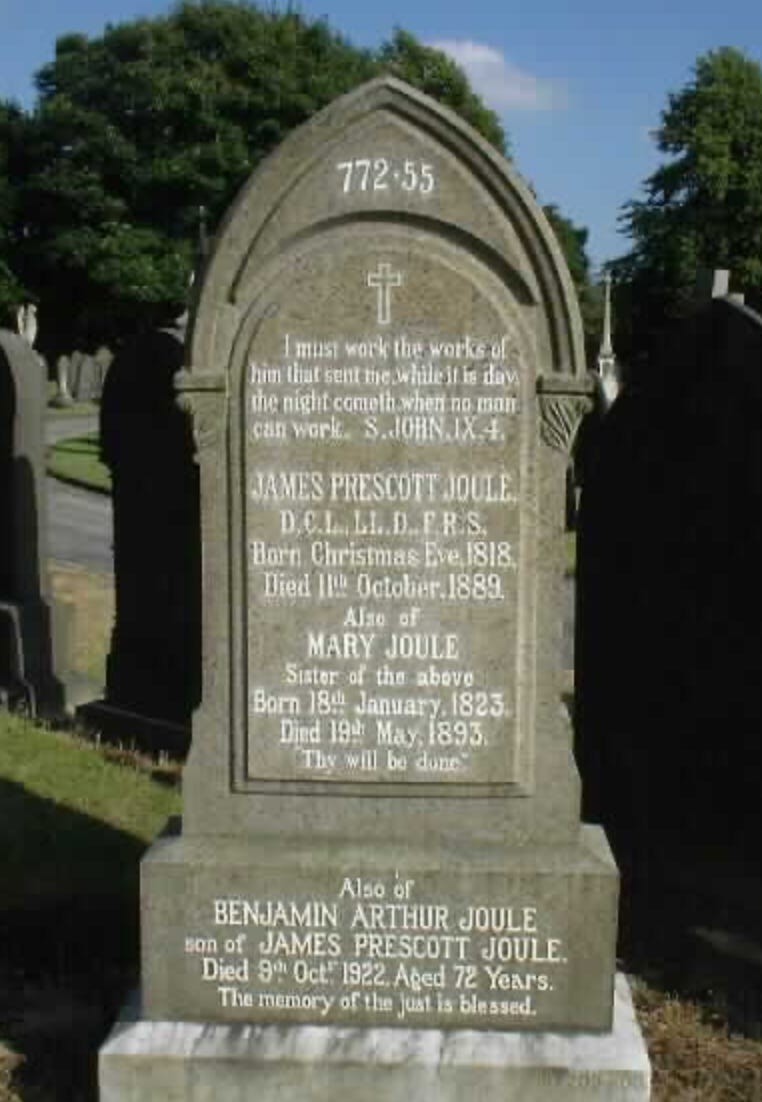
His gravestone, in Sale, Greater Manchester, has the number 772.55 engraved on it, the magnitude of work required to heat a pound of water by one degree in foot-pounds.
The Boiling Amazon
For hundreds of years, legends spoke of a boiling river in the Amazonian jungle. In 2011, geoscientist Andrés Ruzo rediscovered and began studying the river. The average temperature of the water is 86°C and is heated by hot springs powered by geological fault lines.
The Human Body: A Power Plant
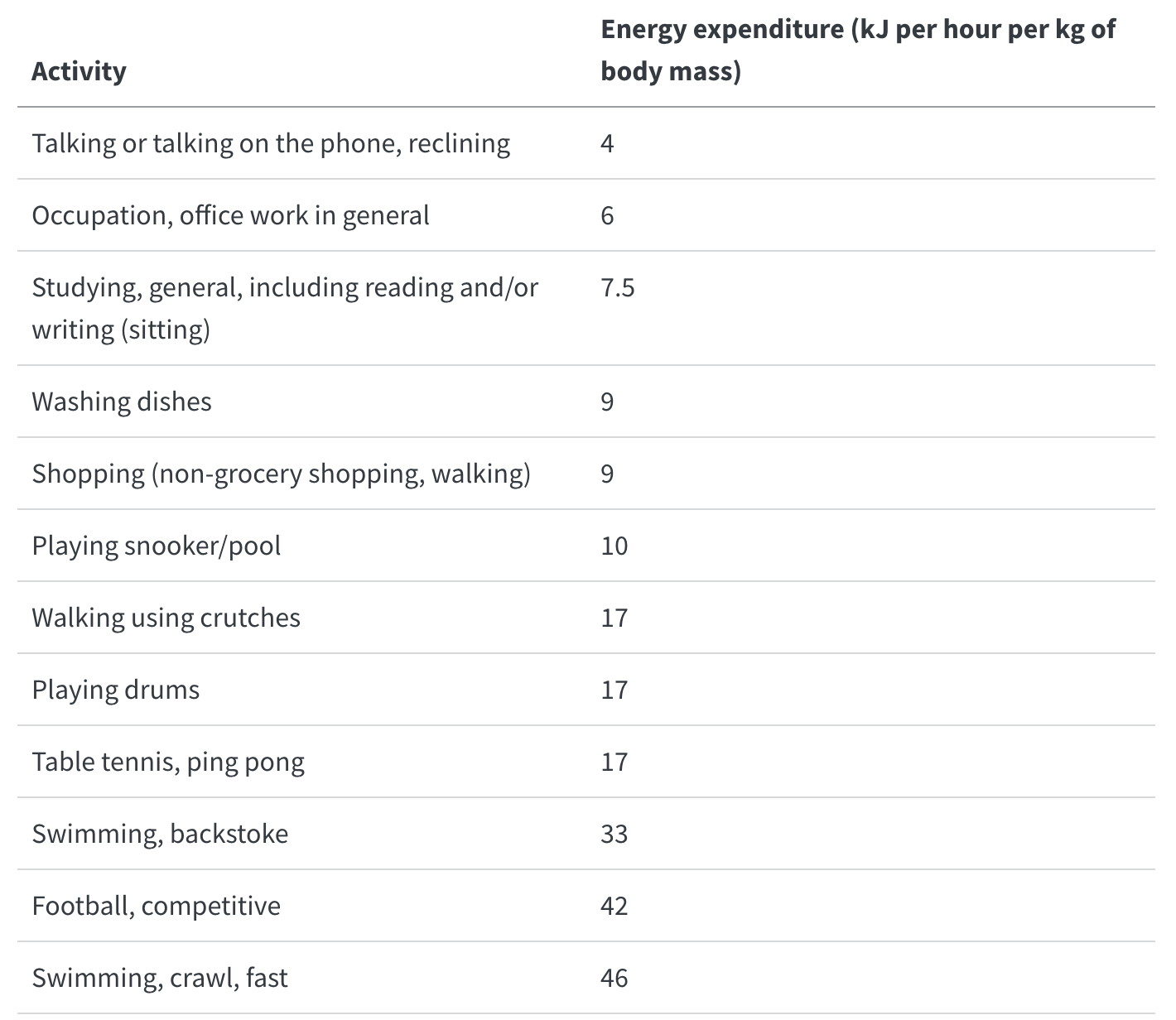
The average human at rest produces about 100 watts of power—roughly the same as a light bulb. But a sprinter can output over 1,000 watts in a short burst. Our bodies convert chemical energy from food into mechanical work and heat. Understanding this helped develop sports science and ergonomics.
Practical work and Demos
The Pendulum…
There is a particular hush that falls over a room when you hold a heavy pendulum bob against your face, the audience knowing that you’re about to release it and risk1 your good looks…
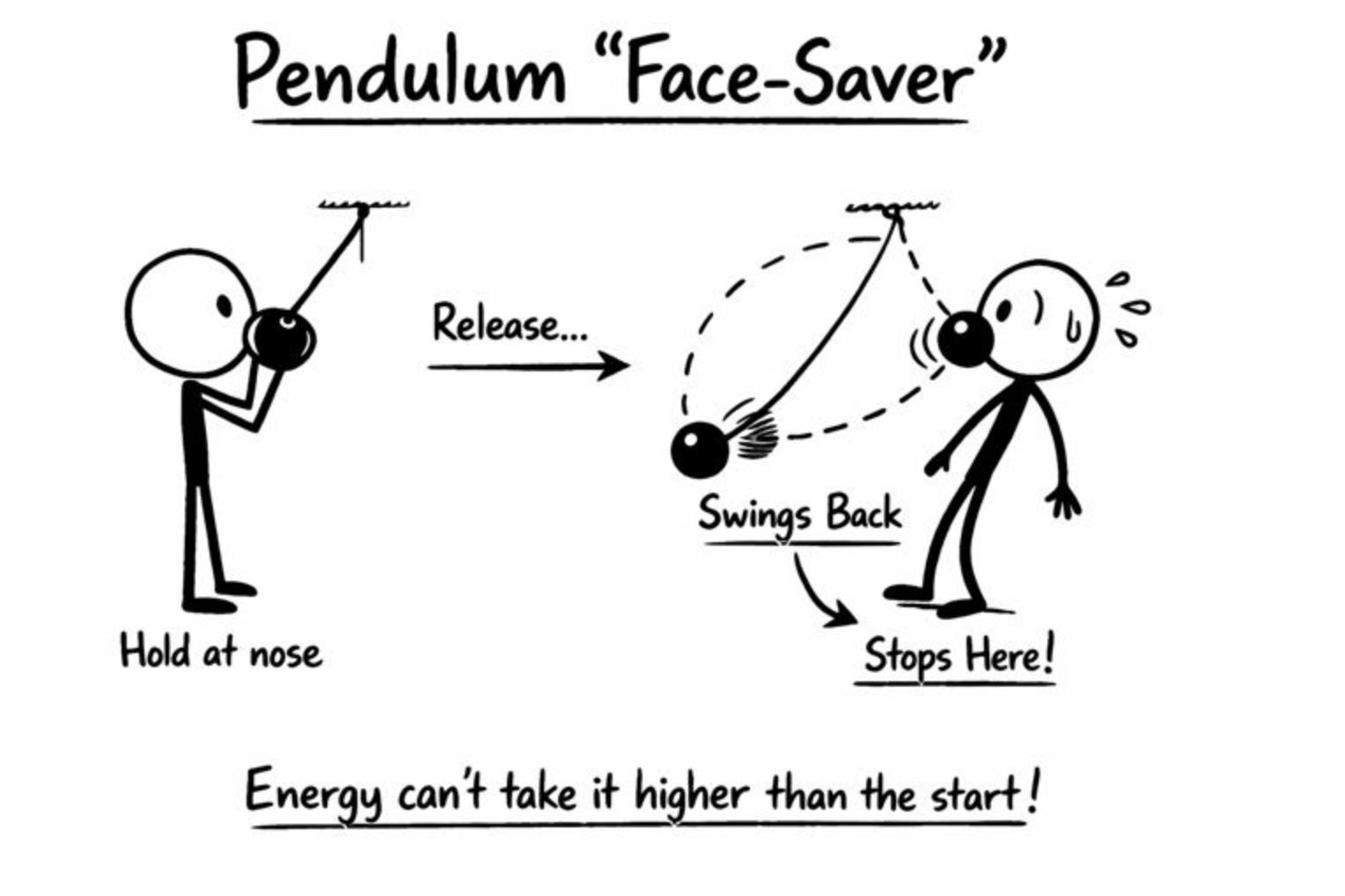
When you release it, and I use a bowling ball as a bob, do so carefully, without pushing. The pendulum will swing away and return, slowing just before it reaches your nose again.
The drama comes from certainty: you are confident it will not hit you. That confidence rests entirely on energy conservation. The gravitational potential energy the pendulum starts with is all it will ever have. Some is lost to air resistance and sound, but none is gained. The pendulum cannot rise higher than its starting point, and so your face remains intact.
It is one of the few demonstrations where trust in physics is visible on the teacher’s body. Note that if you do this with students, take care that the students do not instinctively lean back in the set-up phase then straighten up…
Driving the Track With Your Arms
One of the best little toys for energy I ever found is a hand-cranked slot car track. The change to manual crank turns a familiar toy into a lesson in energy conservation that students can feel in their forearms. As the handle is turned, the car accelerates smoothly around the circuit. Turn faster and it speeds up; ease off and it slows, sometimes stuttering to a halt. There is no mystery to where the kinetic energy comes from. Chemical energy in muscles is transferred, through the crank and motor, into electrical energy and then into the kinetic energy of the car. Friction in the gears, resistance in the wires, and drag on the car steadily siphon energy away as thermal energy and sound.
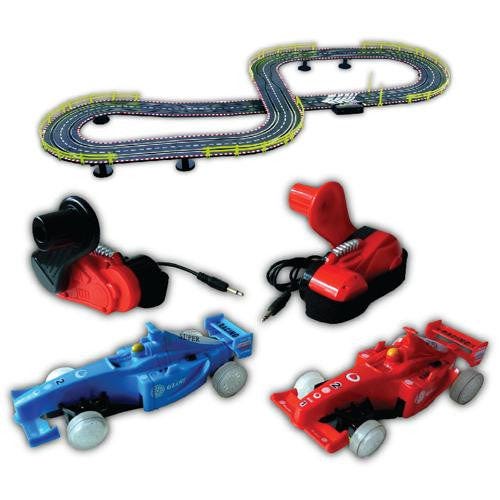
What makes the demonstration powerful is the feedback. If the car is pushed harder into a bend or the track is made longer, the handle becomes more difficult to turn. Students instinctively recognise the trade-off: maintaining speed requires continuous energy input. As the cranking slows, the car slows and stops, not because energy conservation has failed, but because energy is being transferred elsewhere faster than it is being supplied.
Cars and carpet
One of the misconceptions that appears commonly is the need to push an object to cause it to move, as opposed to accelerating it. This comes about principally due to our experience of everything suffering friction. A very nice demonstration of work done against friction is in the braking of a toy car or trolley as it rolls down a ramp on to a piece of carpet. By measuring the stopping distance, and the energy involved, one can find the braking force. This can be done by either measuring the loss of potential energy as it runs down the ramp and on to the carpet or finding the loss of kinetic energy by measuring its speed with a light gate as it reaches the carpet.
Simmilar things can be done by comparing the height drop of the cresta-run with the final velocity of the sledders. In many parts of the UK you’ll see escape lanes filled with gravel at the sides of steep hills to stop runaway traffic. There are some spectacular videos of these in action on youtube.
For a car of mass m travelling down a ramp from a height h and reaching a speed v at the bottom:
Loss of kinetic energy as it brakes to a stop on the carpet = Braking force (F) x Braking distance (d)
Potential energy lost in travelling down the ramp = mgh
If we assume that this is all converted to kinetic energy then mgh = Fd
If we use the velocity and therefore the kinetic energy at the base of the ramp then we can ignore the effect of friction on the the ramp.
Crumple zones
I like to illustrate the crumple-zone with a little competition. I place a solid block at the base of a ramp down which cars can be rolled. Students have eg. 20 minutes, a meter of tape and 5 sheets of A4 paper with which to reduce the impact of the car on the block. It’s fun to measure this with an accelerometer (you could use a phone and phy-phox) or a force meter. For a less precise (but more fun version) challenge students to protect an egg passenger on the top of the cart.
Either way there’s lots of opportunity to relate GPE to KE to work done and link these ideas with impulse and newton’s second law.
The speed ($v$) at which the cylinder (crumple zone) hits the floor (a solid block) can be found from:
where:
h is the height fallen and
g is the acceleration due to gravity (9.81 $ms^{-2}$).
Are you more powerful than Yoda?
The core of this investiagation is a classic experiment to measure a pupil’s power - they carry their own mass (themselves) up a known height. The pupils run up a flight of stairs of known height and measure the time that they take to do it. They then can measure their own weight or use “the international standard physicist mass2“ of 80Kg and so calculate the work done and the power that they developed. Carrying a rucksack loaded with books will increase their weight.
The second part of this was inspired by the wonderful https://what-if.xkcd.com/3/. In turn that was inspired by the great SMBC comic exploring the geopolitical consequences of having Superman turn a crank to provide an unlimited source of energy.
Yoda’s greatest display of raw power in the original trilogy came when he lifted Luke’s X-Wing from the swamp. As far as physically moving objects around goes, this was easily the biggest expenditure of energy through the Force we saw from anyone in the trilogy.
I tend to walk the students through the following fermi-problem:
The energy it takes to lift an object to height h is equal to the object’s mass times the force of gravity times the height it’s lifted. The X-Wing scene lets us use this to put a lower limit on Yoda’s peak power output.
First we need to know how heavy the ship was. The X-Wing’s mass has never been canonically established, but its length has—12.5 meters. An F-22 is 19 meters long and weighs 19,700 kg, so scaling down from this gives an estimate for the X-Wing of about 12,000 lbs (5 metric tons).
Next, we need to know how fast it was rising...
We go over footage of the scene (lots of sources on youtube) and we time the X-Wing’s rate of ascent as it was emerging from the water. The front landing strut rises out of the water in about three and a half seconds, and I estimate the strut to be 1.4 meters long (based on a scene in A New Hope where a crew member squeezes past it), which tells us the X-Wing was rising at 0.39 m/s.
Lastly, we need to know the strength of gravity on Dagobah. Wookieepeedia has a catalog of such things and informs us that the surface gravity on Dagobah is 0.9g. Combining this with the X-Wing mass and lift rate gives us our peak power output:
Note that in the experiment it’s advisable to only allow one pupil at a time to run up the stairs. A slope is better if you have one available. I always give a good warning about taking care, wearing sensible footwear etc. If you think your class are likely to be over enthusiastic which would lead to falls and injuries, please skip this. An accessible alternative is to lift a heavy mass through a measured distance with one or two hands, again the mass should be light enough to not cause injury and no pupil should lift a weight higher than their own shoulders. Warn of back damage here.
Sizzle and slice
This is an old demo that I found in a 30s book of teaching physics - I’ve since seen it a few times but never under this (rather good) name till I recently came on a post by the excellent Simon Poliakoff who makes great stuff available here: https://www.teachphysics.org
In this demo a pendulum bob swings down and its speed is predicted with conservation of energy and then a razor blade cuts the thread and it becomes a horizontally launched projectile. The challenge is to calculate where it will land - I often try to get students to land the ball in the finger hole of a bowling ball:
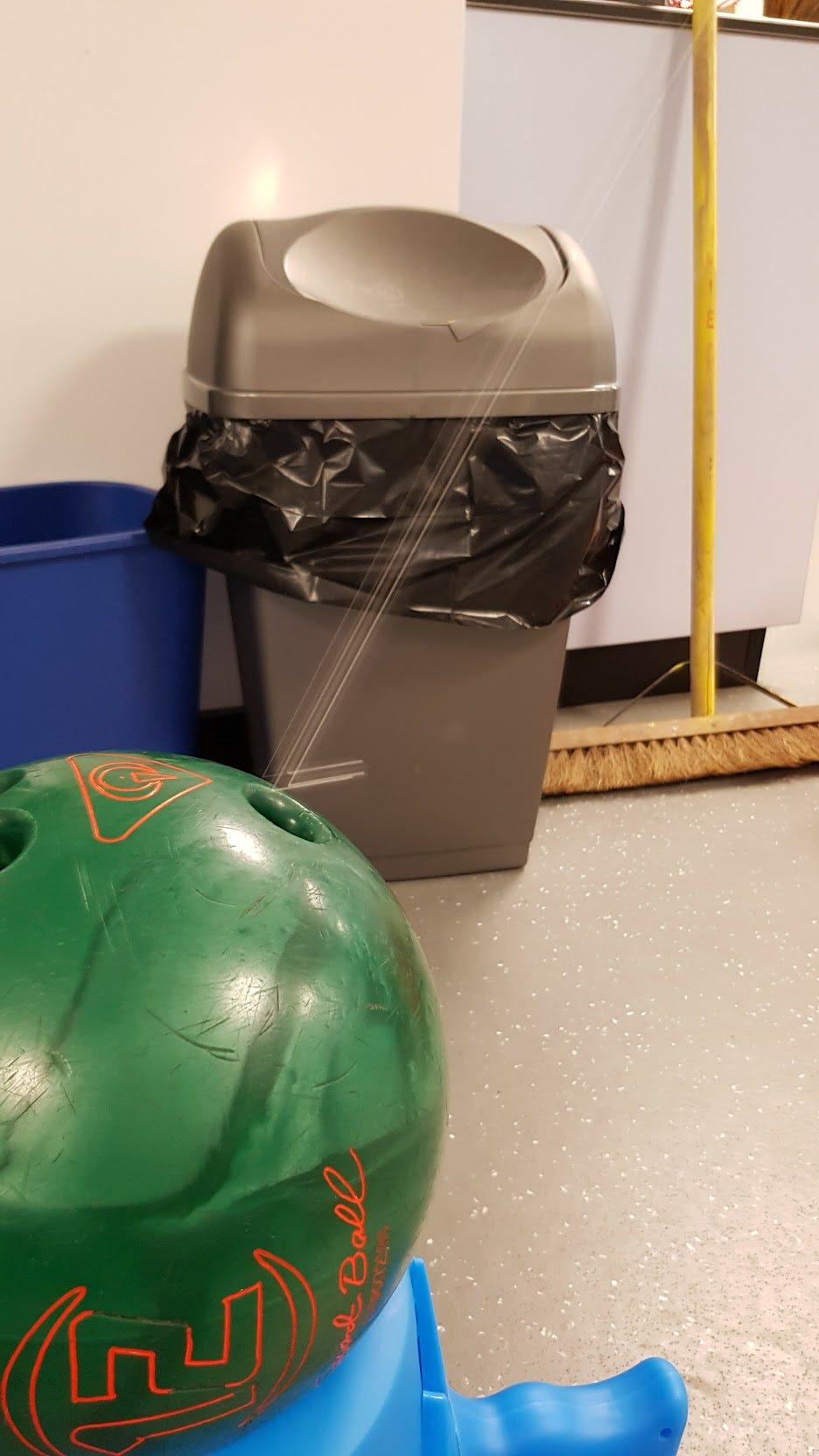
full instructions here
Not at all really.
No, it’s not a real thing but it should be. It saves a lot of angst in young people to use an arbitrary weight/mass rather than theirs.