
The Homopolar Motor
A Simple Marvel of Physics

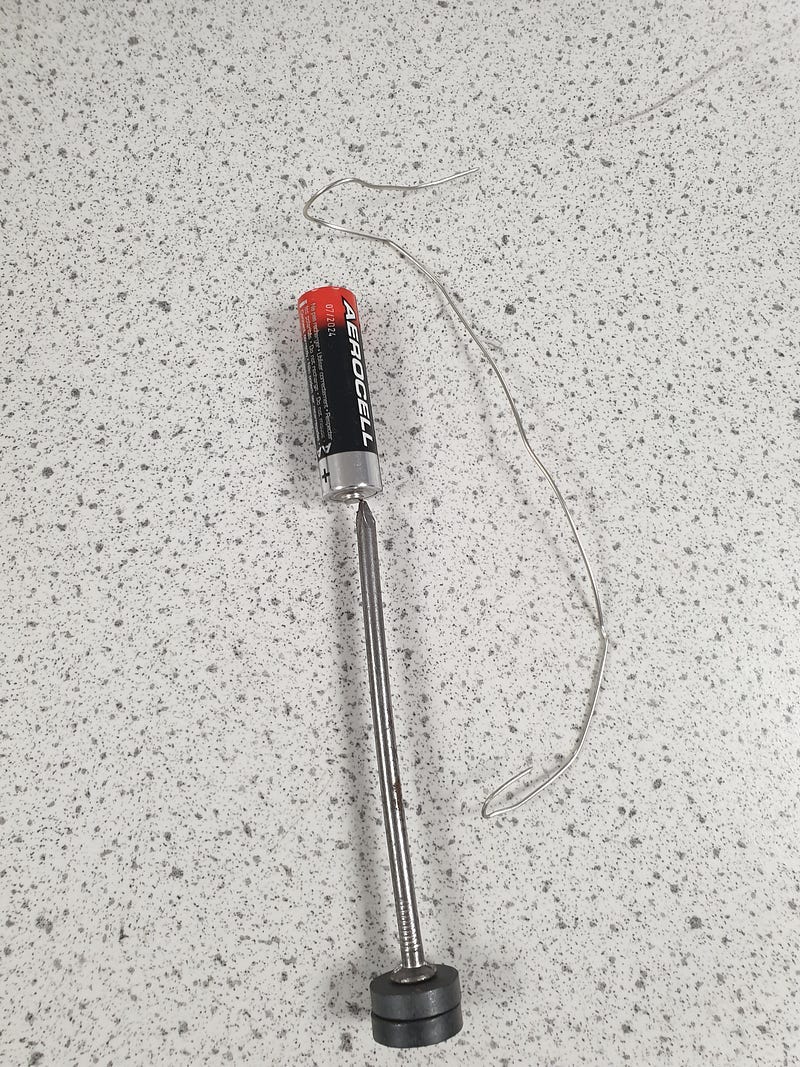
If you’re ever looking for a way to demonstrate a fun and fascinating part of electromagnetism, few classroom demonstrations beat the elegance of a homopolar motor. It’s one of those rare experiments that combine simplicity, accessibility, and sheer visual impact. All you need is a battery, a magnet, and a piece of wire, and suddenly, you’ve got a motor spinning before your eyes. Best of all, beneath that simplicity lies some profound physics.
A homopolar motor is one of the simplest types of electric motors, operating using direct current (DC). Unlike conventional motors, it doesn’t rely on alternating current or complex commutators. Instead, it uses a single magnetic field and a direct current to produce rotational motion.
At its core, the homopolar motor demonstrates the interaction between electricity and magnetism, elegantly encapsulated in the Lorentz force law. When an electric current passes through the wire, a magnetic field is created. If this is in the presence of a magnetic field, the moving charges experience a force perpendicular to both their direction of motion and the magnetic field. This force creates the torque that sets the screw spinning. See this lovely image from wikipedia:
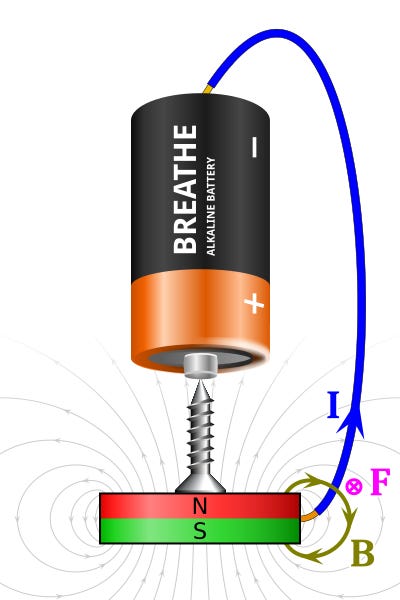
The term ‘homopolar’ refers to the fact that the magnetic field remains uniform and doesn’t change polarity during the motor’s operation. This stands in contrast to most other electric motors, where the magnetic poles are alternated to maintain rotation.
In my own physics classroom, the homopolar motor is a surefire way to grab students’ attention. It’s tactile, immediate, and sparks curiosity. Students can construct one in minutes, and the ‘wow’ moment when the wire begins to spin is always worth it. Plus, it’s an excellent gateway into deeper discussions about electromagnetic forces, motor design, and even real-world applications like electric vehicles.