
Teaching Physics Tips - Gravity
Some theory, stories, and practical activities

Basic Theory
Gravitational Force
Newton’s law of universal gravitation:
Gravitational Field Strength (g)
Defined as force per unit mass:
Near Earth’s surface, approximately:
Direction of g is towards the mass creating the field.
Gravitational Field Due to a Point Mass
Gravitational Potential
Gravitational potential at a point is the work done per unit mass to bring a small test mass from infinity to that point:
Negative sign indicates work done by the field.
Relationship Between g and Potential
Gravitational field strength is the rate of change of gravitational potential. In A-level terms this means that on a potential graph, the gradient gives the field strength at that point.
Potential Energy in a Gravitational Field
Gravitational potential energy of a mass m at distance r:
Escape Velocity
The minimum velocity needed to escape the gravitational field without further propulsion:
Where:
R = radius of the planet/star (m)
Orbits and Circular Motion
For a satellite orbiting mass M at radius r, centripetal force provided by gravity:
Orbital period T:
Uniform Gravitational Field Approximation
Near Earth’s surface, g is nearly constant over small distances.
Use F = mg for weight and W = mgh for gravitational potential energy changes.
Stories to enrich
Newton’s Apple and the Invisible Pull
The story of Newton and the apple goes like this:
In 1665, a young Isaac Newton was back at his family home in Woolsthorpe, having fled Cambridge because the Great Plague had shut the university. One day, while sitting in the garden (often said to be under an apple tree), Newton watched an apple fall straight down to the ground.
The key point isn’t that the apple hit him on the head — that bit is almost certainly a myth. What mattered was the question it triggered:
Why does the apple fall straight down?
Why not sideways, or upwards?
And does the same thing that pulls the apple down also reach as far as the Moon?
Newton began to wonder whether the force pulling the apple to the Earth was the same force that keeps the Moon in orbit. If gravity weakened with distance, perhaps it could explain both everyday falling objects and the motion of the planets.
Over time, these thoughts grew into:
the law of universal gravitation
the idea that the same physical laws apply everywhere
and eventually, the mathematics that would underpin much of classical physics for the next 200 years
Years later, Newton himself confirmed the apple story in conversations and letters, including to his biographer William Stukeley, who wrote that Newton told him the idea of gravity was prompted by seeing an apple fall.
Cavendish’s “Weighing the Earth” Experiment
Henry Cavendish’s experiment, carried out in 1797–1798, is often described as “weighing the Earth”, though what he actually did was measure the gravitational attraction between laboratory-sized masses.
Cavendish used a torsion balance: a light horizontal rod suspended by a very thin wire, with a small lead sphere at each end. Two much larger lead spheres were positioned close to the small ones. When the large spheres were moved into place, their gravitational attraction caused the rod to twist slightly, turning the wire by a tiny angle.
The twist was extremely small, so Cavendish measured it using a telescope to observe the movement of a reflected scale. From the angle of rotation and the known stiffness of the wire, he calculated the gravitational force between the lead spheres. This was the first successful measurement of gravity acting between ordinary objects in a laboratory.
Using Newton’s law of gravitation, Cavendish compared this force with the gravitational force experienced at the Earth’s surface. From this comparison, he calculated the mass and mean density of the Earth. He reported the Earth’s density as about 5.5 times that of water, very close to the modern accepted value.
Cavendish himself did not frame the experiment as measuring the gravitational constant GG, but his results allowed later scientists to calculate it. The experiment showed that gravity is a universal force acting between all masses, not just planets, and remains one of the most precise experiments of the eighteenth century.
The First Gravitational Wave Detection
In 2015, the LIGO observatory measured ripples in spacetime caused by colliding black holes—direct evidence of dynamic gravitational fields moving at light speed. This discovery confirmed Einstein’s prediction and opened a new way to “hear” the universe’s most violent events.
The Falling Feather and the Feather and the Hammer on the Moon
Apollo 15 astronaut David Scott dropped a feather and a hammer on the Moon’s surface. Without air resistance, both hit the ground at the same time—showing gravity’s uniform effect on all masses. This simple demonstration revealed the universality of free fall—a key idea in gravitational fields.
Black Holes: Gravity’s Ultimate Prison
Black holes form when gravity’s field becomes so intense that not even light can escape. Scientists realized these objects challenge classical ideas about gravitational fields, warping spacetime into regions with event horizons. Studying black holes pushes the limits of our understanding of gravity.
Galileo’s Tower of Pisa Experiment
Legend says Galileo dropped balls of different masses from the Leaning Tower of Pisa, showing they fall at the same rate, disproving Aristotle’s idea that heavier objects fall faster. This was an early insight into gravitational acceleration and helped lay the groundwork for gravitational fields.
The Pioneer Anomaly: Gravity’s Unexplained Pull?
In the late 20th century, the Pioneer 10 and 11 spacecraft showed tiny unexplained deviations from predicted trajectories. Scientists wondered if our understanding of gravitational fields was incomplete. Though later explained by heat recoil forces, the mystery inspired new investigations into gravity’s reach.
Practical work and Demos
Gravity is weak
Probably the simplest demonstration in the whole book is one that shows us the relative strength of the forces of Electromagnetism and Gravity.
Hold a pen lightly at arms-length - that’s it!
The gravitational force between the pen and the Earth is easily overcome, without any noticeable effort, by the electromagnetic interaction between your fingers and the surface of the pen. You can revisit this at A-level and show that the gravitational attraction between two protons is $\approx 10^{-36}$ times weaker than the electromagnetic force between them which is why electromagnetism dominates everyday life, while gravity dominates on astronomical scales (where objects are neutral and mass is enormous).
Groan Tube
The groan tube is one of those fantastic toys that doubles as a physics demo. Turn it upside down and drop it mid-groan. The change in the sound as it goes down is an excellent way to show the constancy of vertical acceleration in free fall and also to demonstrate g forces. The groan stops in free fall and starts again when the high deceleration forces occur as it is caught.
Pearls in air
This is a classic demonstration designed to show the parabolic path of projectiles in a gravitational field. A water jet is formed by using the glass part of a dropping pipette fixed to a thinwalled rubber tube and connected to the water tap. The rubber tube is passed through an old-style ticker timer or over a vibration generator so that the tube is alternately squeezed and released when the device is switched on.
The water jet falls in a parabola from an initial horizontal direction but is also interrupted by the pulsing so that droplets of water are formed instead of a continuous stream. If the arrangement is illuminated with a stroboscope, pearl-like droplets of water can be made to stand still or move slowly through the air. The constant horizontal velocity and the increasing vertical velocity can be seen by observing the positions of successive drops. To get a permanent record you could mark the position of the shadows of the water drops on a screen behind the jet or even photograph it. A truly beautiful demonstration.
Warnings about the use of stroboscopes or flashing lights should be given for all sections of this experiment. Any pupil suffering from photo-sensitivity should be allowed to leave if they request it.
Diluted gravity
Realising the problem of making accurate measurements of the acceleration due to gravity, Galileo diluted gravity by rolling balls down slopes. His original apparatus is in the History of Science Museum, Florence. We can recreate his experiment by rolling a marble down an inclined plastic ramp or tube and measuring the time it takes to travel a measured distance.
The gravitational acceleration (g) has been “diluted” to g sinA where A is the angle that the tube makes with the horizontal.
A piece of aluminium extrusion supported by a strip of wood makes an excellent ramp down which to roll the marbles.
Vertical acceleration & “Jupiwater”
To create a hands-on demonstration of how weight changes on different planets, start by collecting opaque milk bottlesof similar size. Fill each bottle with water, sand, or rice so that the mass inside totals 1 kg. This ensures the mass of the bottle itself is consistent, but the content can be adjusted slightly for fine-tuning if needed.
Label each bottle clearly with the name of a planet (e.g., Earth, Moon, Mars, Jupiter). Next, calculate the apparent weight on each planet by multiplying the mass by the planet’s surface gravity (for example, on the Moon, a 1 kg mass weighs about 1.6 N instead of 9.8 N). Adjust the contents of each bottle so that when lifted, students feel the correct relative weight corresponding to that planet.
Set up a still area free of tripping hazards where students can safely lift the bottles one at a time. Encourage them to notice the difference in effort required for each “planet” and to compare the relative difficulty of lifting heavy and light bottles.
This simple setup lets students experience the effect of gravity without complex equipment. They can discuss why the same mass feels lighter or heavier on different planets and relate it to the acceleration due to gravity. Using opaque bottles keeps the focus on perceived weight rather than guessing from size or contents.
Two balls falling joined by stretched elastic - or dropping a slinky
An interesting problem involving gravity is to take two balls that are joined together by a piece of stretched elastic and hold one of them so that the other hangs below it, the elastic between them being stretched. Now release them so that they fall. What happens to their separation as they fall? It is worth doing the experiment, first with two balls of the same mass and then with two of different masses. With the two different masses try it with the greater mass at either the top or bottom.
A variation of the experiment is to drop an extended slinky and observe what happens to various parts of it as it falls. You will find that during the drop the bottom coils stay where they are while the upper coils catch up with them and then the whole spring falls together. During the whole motion the centre of mass falls with an acceleration of g. The information that the spring is falling will take a certain time to travel down the spring and so initially the bottom part of the spring “thinks” it is still being held up and so remains at rest.
Monkey and hunter
A monkey hangs from a tree in a jungle and is discovered by a hunter who decides to shoot it. Pointing the rifle between the eyes of the monkey he prepares to pull the trigger. The monkey, being fairly intelligent, reasons that if he waits until the moment the bullet leaves the barrel and then drops out of the tree the bullet will pass over his head. The hunter pulls the trigger, the monkey waits until the bullet is leaving the barrel and then lets go. To his dismay the bullet hits him directly between the eyes! He was intelligent but had forgotten his Physics!
The explanation for this can be demonstrated by a classic experiment that shows the constancy of acceleration for falling bodies.
Mount an electromagnet in a clamp about 0.5 m above the bench and mount a blowpipe horizontally in another clamp so that it is pointing just below the core of the electromagnet. Put a marble in the blowpipe, fix a small strip of aluminium foil across the mouth of the blowpipe and then connect up a series circuit with the electromagnet, a d.c. power source and the aluminium strip.
Switch on and hang a tin lid from the electromagnet making sure that the blowpipe is pointing at the centre of the tin. Blow sharply down the pipe and the marble will fly out, breaking the foil, and causing the tin lid to fall. The marble will fall at the same rate as the tin lid and should collide with it before hitting the bench.
Falling through the Earth
A related problem in gravitation refers to the fact that it takes 42 minutes for objects falling through holes in the Earth to reach the other side whatever chord is used. (This is of course a theoretical and ideal situation and ignores all frictional effects!) It would make an ideal and rapid transport system. You can extend the idea to SHM where the body is free to oscillate about the centre of the Earth. Students often find it difficult to accept that the acceleration is zero at the centre of the “fall”.
Guinea and feather tube
This is a classic experiment to show the effect of air resistance and the constancy of the acceleration due to gravity. Take a 1 m long glass tube of diameter about 5 cm, put a small piece of feather and a penny into the tube and fit bungs tightly into both ends - one with a metal tube in the centre. Attach the tube to a vacuum pump. Upend the tube and show that the penny falls faster than the feather because it has much lower air resistance. Now pump out the air and show that they both fall at the same rate.
A video clip of astronauts dropping a falcon feather and a hammer on the Moon illustrates this as well. (It is important to realise that on the Moon there is no air, but there is still a gravitational field, about 1/6 of that at the surface of the Earth.) It is certainly not true to say that no air means no gravity.
Two tennis balls.
Take two tennis balls and inject one with water. (Make sure that it is completely full.)
Then ask them to hold the balls to show that although they are of different mass they still accelerate at the same rate in a gravitational field.
Cavendish Revisited:
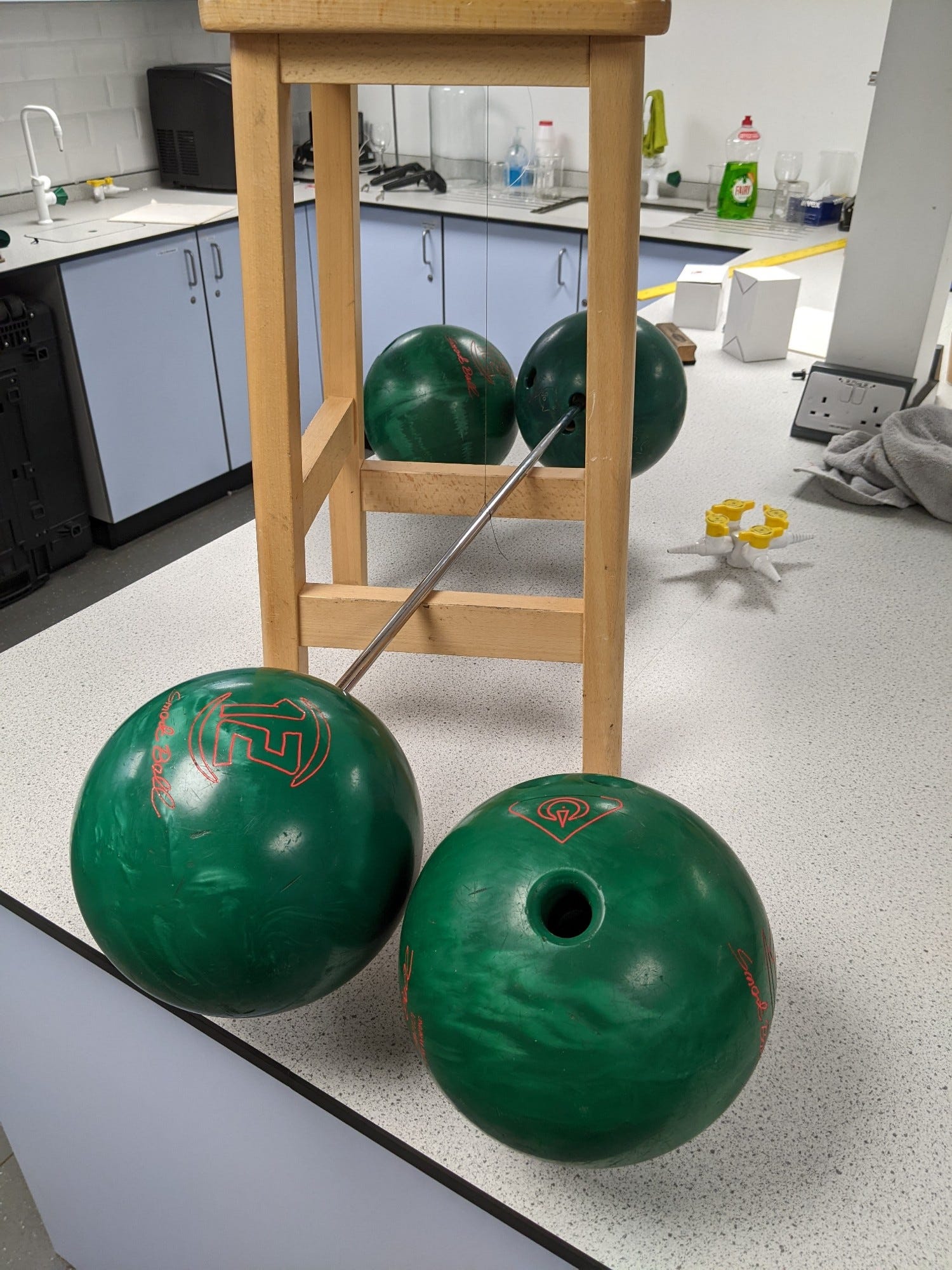
I’ve had various success with this and I’m not convinced it every works properly, but I am convinced that it’s a great talking point - To replicate a Cavendish-style experiment using visible masses, start by setting up a sturdy support in a still, vibration-free lab to minimize disturbances. From the top of this support, suspend a metal rod horizontally using a thin, strong wire so that it can rotate freely around its midpoint. The rod should be balanced carefully so that it sits level when at rest.
Next, attach two medium-sized bowling balls at each end of the rod. These represent the smaller “test” masses in the original Cavendish experiment. Make sure they are secure and that the rod remains horizontal. On either side of the rod, place the other two bowling balls, which act as the larger “source” masses. Position them close enough to the small balls that their gravitational attraction will cause a visible deflection, but ensure they do not touch.
To observe the rotation, mark a reference line or attach a pointer to the rod, allowing you to measure how far it moves. Once everything is set, let the rod settle into its equilibrium position. Carefully move the large masses to one side and watch as the small balls slowly rotate toward them, illustrating the effect of gravitational attraction. You can then reverse the position of the large masses to see the rod swing the other way.
This simple setup allows the invisible force of gravity to be observed at a human scale. Students can discuss how the small rotation mimics the torque measured in Cavendish’s original experiment and reflect on how the deflection depends on the size and distance of the masses. While the forces here are exaggerated for visibility, the principle is the same: gravity, though weak, acts between all masses.
Great hands-on experimentation ideas as always!