
Snap, Crackle, Pop!
we need more Jerks

Displacement that changes over time, we call velocity.
Velocity that changes over time, we call acceleration.
Yes, yes — all very familiar — but stick with it.
What is much less commonly discussed is that this chain of “change over time” does not stop there. In fact, it continues indefinitely, and those higher rates of change turn out to be both physically meaningful and deeply relevant to our everyday experiences. In particular, the change in acceleration over time deserves far more attention than it usually receives. It is not just a mathematical curiosity lurking beyond the A-level syllabus; it is something we feel, react to, and design around.
One intriguing observation is that, of displacement, velocity, and acceleration, we only really experience one directly: acceleration. As many GCSE students can tell you, force and acceleration are linked by mass through Newton’s second law. Whenever we experience a force, we are effectively experiencing an acceleration. When a car speeds up, we feel pushed back into the seat. When it slows down, we feel thrown forwards. When it turns a corner, we feel pushed sideways. All of these sensations arise because our velocity is changing.
At constant velocity, however, we feel nothing at all. Smooth motion at a steady speed is indistinguishable from rest — a fact that underpins everything from Galileo’s relativity to why smooth train journeys can lull us to sleep.
If we can sense acceleration, and also sense its absence, then it follows that we can sense changes in acceleration. In other words, we can feel how forces themselves vary over time. To describe this properly, we need a term that rarely appears in school physics:
Jerk.
Jerk is the rate of change of acceleration with time. It describes how quickly an acceleration is applied or removed. Although the word may sound unfamiliar — or even faintly comic — the sensation it describes is not. Jerk is the suddenness of a force. It is the difference between being smoothly pushed and being sharply yanked.
Consider a car pulling away from traffic lights. The car’s acceleration is not constant. It ramps up from zero, perhaps overshoots slightly, then settles. During this process, the acceleration itself is changing, which means the dominant sensation you feel is not acceleration but jerk. A skilled driver minimises jerk; a learner driver often does not. The resulting judder, discomfort, and head-nodding are not due to large accelerations, but to rapidly changing ones.
But what has breakfast cereal got to do with any of this?
“Snap, crackle and pop” — in this context — have nothing to do with rice-based nutrition and everything to do with continuing the hierarchy of change.
Snap is the rate of change of jerk
Crackle is the rate of change of snap
Pop is the rate of change of crackle
Absurd as this may sound, the logic is entirely consistent. Each quantity describes how the previous one changes with time. While these higher derivatives are rarely needed in everyday calculations, they are extremely useful in understanding comfort, safety, and mechanical design.
To see why, consider this: velocity does not suddenly “switch on” from zero — it grows smoothly. That growth implies acceleration. But acceleration itself does not suddenly switch on either; it also builds up from zero. That requires jerk. And if jerk builds up gradually, then there must be snap, and so on. Real physical systems tend to avoid sudden changes at any level, because abrupt changes imply large forces and stresses.
A practical demonstration of this comes from a simple experiment: Taking a Phyphox equipped phone out for a bicycle ride;
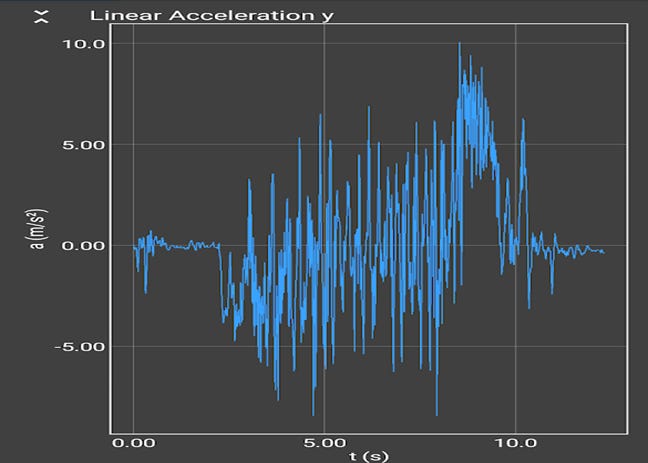
In the first few seconds of the journey, the bike rolls along smooth, newly laid tarmac. The ride feels calm and controlled, and the recorded acceleration changes very little. The jerk is small. After a few seconds, the surface becomes older and rougher. Vibrations appear, the ride becomes uncomfortable, and the acceleration signal fluctuates rapidly — clear evidence of increased jerk. Finally, at around eight seconds, the bike hits a pothole. The acceleration changes violently in a very short time, producing a large spike in jerk and a very real feeling of being nearly thrown from the saddle.
Cornering provides an even richer context for discussing why jerk matters. When a vehicle turns, it experiences a centripetal acceleration towards the centre of the curve. A sudden transition from straight to curved motion implies a sudden appearance of centripetal acceleration — and therefore a large jerk. Passengers feel this as a sharp sideways lurch.
In railway and road design, this is not merely uncomfortable but dangerous. Abrupt changes in acceleration increase the risk of derailment, loss of traction, or structural failure. To avoid this, engineers use transition curves known as clothoids. These curves allow the curvature — and hence the centripetal acceleration — to increase gradually. In effect, the jerk is controlled and limited, often producing approximately constant snap. The result is a smooth, predictable, and safe transition into a bend.
The same principle applies in motorsport. Grip is limited by friction, and any sudden peak in the force required to turn can exceed that limit, causing the vehicle to slide or spin. The fastest and safest racing line into and out of a corner is therefore one that increases acceleration smoothly — again, closely approximating a clothoid. Many crashes occur not in the middle of bends, but on corner entry, where the change in acceleration is too abrupt and the jerk too large.
So while jerk may sit beyond the formal A-level syllabus, it sits squarely within students’ lived experiences. It explains discomfort, judder, vibration, and loss of control. It links mechanics to engineering, transport, sport, and even phone sensors. Perhaps most importantly, it deepens students’ understanding that physics is not just about quantities, but about how those quantities change.
In summary, then: maybe it’s time we went one derivative further in our mechanics teaching — and talked about jerk a bit more.