
Shocking Gates and Glowing bulbs: The Science Behind Electromagnetic Induction
A favourite geographical oddity...

Have you ever approached a metal gate near overhead power lines and felt an unexpected shock? While it might seem like magic or a fault in the power system, the explanation lies in the fascinating physics of electromagnetic induction. In cases like the above, where the wires are close to a metal gate, the high-voltage power lines can induce an electric charge on nearby metal objects, even without direct contact.
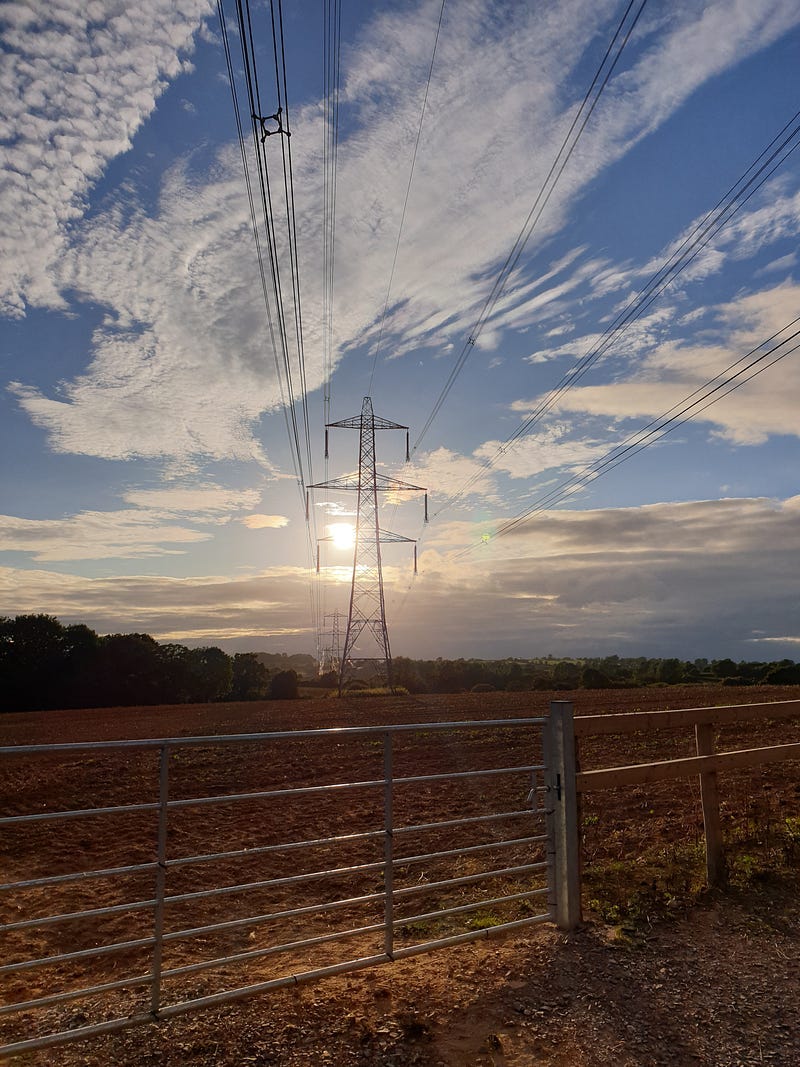
At its core, electromagnetic induction is a process where a changing magnetic field creates an electric current in a conductor. Discovered by Michael Faraday in the 19th century, this principle is the foundation of many technologies, from electric generators to transformers. High-voltage power lines carry alternating current (AC), which means the electric current constantly changes direction. This creates a fluctuating magnetic field around the lines. When a metal object, such as a gate, is positioned close to these power lines, it enters this magnetic field. According to Faraday’s Law of Induction, as the magnetic field from the power lines fluctuates, it induces an electric potential in the gate.
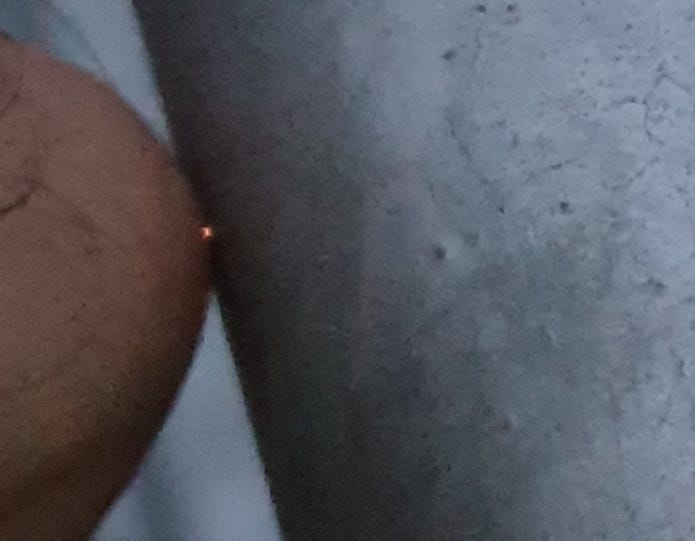
When you touch the gate, your body provides a path for the charge to discharge into the ground, and you might feel a small electric shock. While this voltage is usually not enough to cause harm, it can still be startling. Rather incredibly I managed to get a photo of the shock arcing to Earth through my finger knuckle.
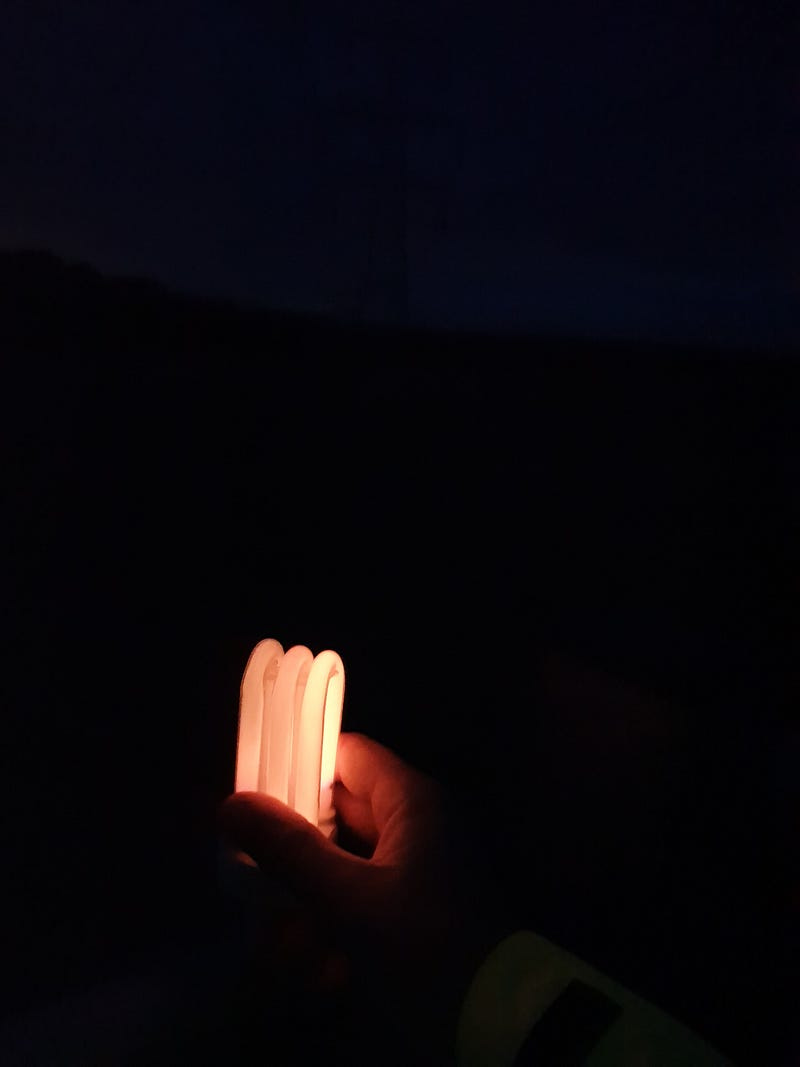
Another fascinating demonstration of this electromagnetic induction is the lighting of a Compact Fluorescent Lamp (CFL) bulb beneath power lines. CFL bulbs contain a small amount of gas and require an electric field to excite the gas particles and produce light. When held under high-voltage power lines, the strong electric field from the overhead cables induces a voltage across the bulb’s internal components.
This induced voltage is enough to ionize the gas inside the bulb, causing it to glow without being plugged into a power source. The effect is stronger when the power lines are carrying higher currents or when the bulb is closer to the lines. In this case the effect is quite marked:
Several factors affect how much voltage gets induced in a metal object near power lines and contribute to the effectiveness of these demonstrations at this location:
Distance from the power lines: The closer the gate or bulb, the stronger the magnetic and electric fields. Our gate is right beneath the lowest part of the lines between two pylons.
Voltage of the power lines: Higher voltages create stronger electromagnetic fields. These lines are approx. 400,000V.
Environmental conditions: Humidity and soil conductivity also play a role. Technically the environmental conditions change the dielectric constant of the air, changing how well the magnetic field is coupled to the gate.
Electromagnetic induction is a powerful phenomenon that explains how metal gates near high-voltage power lines can become electrified and how a CFL bulb can glow beneath them. While it might seem like a mysterious occurrence, it’s simply physics at work.
Thanks for sharing Joe. I suspect most of these effects are caused by the electric field and not the magnetic field. The current across the three phases will sum to approximately zero so I think the magnetic field will be very small.